No. In the US, bookkeeping is not a licensed profession. Here’s what is regulated, what isn’t, and what a US client checks before they trust you with their books.
We get this question at every webinar we run. It comes in a different form each time: “Is my ISOS certificate valid in the US?” “Do I need to become a CPA first?” “Will an American company accept a Macedonian license?”
It’s a fair question. In most European countries, keeping books for other companies is a regulated profession. In Macedonia, you need an ISOS certificate and a place in its register, and only an authorized accountant can sign a company’s annual accounts. So it makes sense to look for the American version of that license before you start.
But there isn’t one.
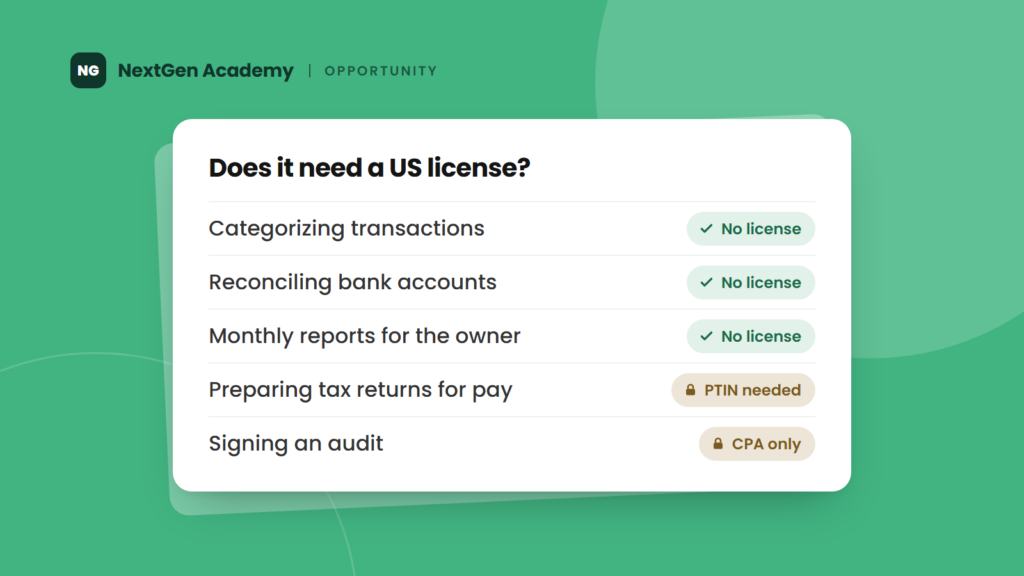
In the US, you don’t need a license to do bookkeeping. Licenses are for signing audits and preparing tax returns, and neither of those is bookkeeping.
This is not a gap in the rules. It’s how the US market works, and it’s the reason US businesses and accounting firms can work with bookkeepers outside the country at all.
What is actually regulated in the US
There are three situations where you need a license or a registration.
Being a CPA and signing audits. A Certified Public Accountant is licensed by a state board of accountancy. Only a licensed CPA can use that title, and only a CPA or a CPA firm can sign an audit or a review of financial statements.
Preparing tax returns for money. Anyone paid to prepare a US federal tax return needs a PTIN, a preparer number from the IRS. There’s a separate route for people outside the US who don’t have a Social Security number. If you only keep the books, you don’t need one.
Speaking to the IRS for a client. When a client is audited or has a dispute with the IRS, a CPA, an enrolled agent, or a tax attorney represents them.
Everything else is bookkeeping, and you don’t need a license for any of it: categorizing transactions, reconciling bank and credit card accounts, managing invoices and bills, recording payroll, and preparing monthly reports. The bookkeeper prepares all of this and, at year-end, sends it to the CPA for tax filing.
The bookkeeper keeps the books right every month. At year-end, the CPA takes those books, prepares the tax return, and signs it. This is how the accounting industry is split in the US. Bookkeeping can be done anywhere in the world.
How we work without a US license
At Books at Ease we keep the books for US small businesses, and the majority of our team is based in Skopje. We don’t file tax returns or do audits. We keep each client’s books tax-ready all year and work alongside their CPA. With the books ready, the CPA can file the tax return in March with minimal work and a minimal fee.
When a US owner chooses a bookkeeper, these are the things they usually check:
- The same person handles their books every month.
- They get a reply the same day.
- Clear pricing, with no hidden fees.
- A person who understands their goals and solves their problems.
Nothing on that list needs a US license. All of it needs skill, care, and good communication.
What about certificates?
Many accountants then look for a certificate instead, because they believe it will prove they can be trusted. Intuit, the company behind QuickBooks, offers a free QuickBooks Online certification. It’s a good starting point, but on its own it won’t get you closer to US clients.
A US owner chooses a bookkeeper who understands their problems and explains the solution clearly. A certificate can support that. It can’t replace it.
The same goes for your ISOS certificate. It doesn’t carry over to the US, and you don’t need it to. What carries over is everything you learned to get it: double-entry, reconciliations, closing a month, finding the mistake in someone else’s books. That’s the part most local accountants already have. They just don’t know how to present it to another market.
Where the real gap is
If the license isn’t the gap, what is?
With the accountants we train, it’s usually one of three things.
US-specific knowledge. How US small businesses are set up, how they pay contractors, how sales tax works, and how QuickBooks Online is used day to day. These skills are learnable, and most of them are closer than you think.
Confidence. “Why would an American company trust me?” You don’t need years of experience to start, and confidence comes from practice more than from reading.
A way to find clients. Knowing how to do something is different from having a client to do it for. This is the part most accountants are never taught.
The one line not to cross
There is one real limit. Don’t call yourself a CPA, and don’t sign tax returns or audit reports. If a client asks you to file their taxes, tell them their CPA handles the filing and you’ll have the books ready for them. US owners are used to this split, and saying it clearly shows you know how the market works.
What this means for you
If the license question has been holding you back, you can put it down. The questions worth your time are different. Can you keep a US company’s books right every month? Can you communicate the way a US owner expects?
You can learn both, and you can start this week.
You don’t need a US license to start. You need US bookkeeping skills and a client who trusts you.