
Four months, built and taught by the founders of a working US bookkeeping firm. Three months of teaching, then a full month where you run a complete bookkeeping cycle yourself, inside a training replica of how our practice actually operates.
No payment on this page. You leave your details, we call you and answer everything.
€580 once, until 31 AugustOr €250 a month × 4. The one-payment price rises to €760 on 1 September and €850 on 16 September. Bank transfer, arranged on the call.
Taught by the team behindBooks at EaseUS-registered bookkeeping practiceNextGen CompanySupporting 100+ US accounting practices20+ accountantsWorking on US books every day
We didn’t start with a curriculum. We started with a bookkeeping firm that serves American small businesses out of Macedonia, and then wrote down how we do the work and how we train someone to do it.
Books at Ease is a registered US bookkeeping practice with American small-business clients, run from Macedonia. NextGen Company supports over 100 US accounting practices with a team of 20+ accountants. This program is a version of the work we do anyway.
Toni and Ana were not hired to deliver a module. They run the practice, they carry the clients, and they are the ones who read your workpapers and tell you what a US client would say about them.
A completed bookkeeping cycle, reconciled accounts, financial statements you produced and a recorded client presentation, plus a two-page credential describing what you did and what was assessed. Things you can put in front of someone, which is what they will actually ask to see.
“Everything I find is theory. Nobody ever shows me the actual work.”
“I don’t have an accounting degree, so every door looks closed before I knock.”
“I can read English fine, but I’ve never written a client email or presented a report in it.”
“I finished a course and got a certificate. I still had nothing to show anyone.”
“I know the terms. I have no idea what a real month actually looks like.”
You learn in Macedonian and you work in English, because that is how the job is actually done. Every subject is taught the way it is used, not the way it is examined.
Set up a chart of accounts and get transactions into QuickBooks Online the way a US firm expects to find them.
Reconcile bank and credit-card accounts, and know what to do when the numbers refuse to agree.
Accruals, adjusting entries, month-end close, and financial statements that someone can actually use.
Build and maintain workpapers, and understand what has to be written down and why.
Email and Slack that reads professionally, asking the right questions, task management, time tracking, time zones, confidentiality.
Present financial reports on camera, scope and price a job, and know where US bookkeeping work is actually found.
Five stages, grouped by theme. Open any one of them to see what it covers. The week-by-week schedule is finalized and shared with your cohort before the start.
Months 1–3 · Core
Where the US accounting world actually sits, and where someone working from Macedonia fits into it. This is the part that turns “I’ve heard of GAAP” into knowing what you’re looking at and why it’s arranged that way.
US bookkeeping fundamentalsGAAP basicsThe US accounting industryWhere a non-US accountant fits inWorking as an international contractorUS tax landscape for non-tax accountants
Months 1–3 · Core
The core craft, and the largest part of the program. Everything from an empty chart of accounts through to a set of financial statements a business owner can make a decision from.
Chart of accountsRecording transactionsTransaction categorizationBank reconciliationCredit-card reconciliationAccounts receivableAccounts payableAccruals & adjusting entriesMonth-end closeFinancial statementsWorkpapers
Months 1–3 · Core
QuickBooks Online is where US small-business bookkeeping happens. You learn it the way a firm uses it day to day, alongside the habits that let someone trust you inside their systems in the first place.
QuickBooks Online navigationQBO processes end to endThe wider US software ecosystemWorking inside client systemsSecurity, confidentiality & least-privilege access
Months 1–3 · Core
The half of the job that decides whether you keep the work. How you write, what you ask and when, how you scope and price, and where US bookkeeping work is actually found. Most courses stop before this part.
Client onboardingTask & workflow managementTime tracking & time zonesProfessional email & SlackAsking the right questionsPresenting financial reportsFinding clients on LinkedIn, Upwork and outreachPreparing for a first interviewScoping workload & pricingEmployment vs freelancing
Month 4 · Practicum
One client, one month, and you run it. Everything from the first three months arrives at once, on your own work, against real deadlines, reviewed by the two people who own the practice.
Onboarding packageTraining Drive & file structureSource documents & statementsWorkpaper buildCategorizationManager questionsReconciliationTime & task reportingMonth-end reviewFinancial reportsRecorded client presentationOne-to-one feedback
Teaching is in Macedonian. The work itself is in English: QuickBooks fields, source documents, client messages, workpapers and reports, because that is the language it exists in. Your English is never tested at the door.
For the final month you step into a training environment built as a replica of how Books at Ease works: its folder structure, its workpapers, its task and time system, its communication standards, its deadlines. You are given a client, and you run their month.
Toni takes the manager’s role. You receive instructions the way our team receives them, and when something doesn’t add up, you raise it the way our team raises it. Some documents will be missing. Some numbers won’t match. That is deliberate, because noticing and asking is most of the job.
At the end you record yourself presenting the financials to camera, the way we send reports to real clients. Then you sit down one-to-one with us and hear precisely what was good and what wasn’t.
We’re specific about this on purpose. It is what makes the claim worth something, and what lets you still stand behind it a year from now.
Everything about the work is real except the client. That is still more than a course can give you, and it holds up when somebody asks what you actually did.
Two pages. The first confirms you completed the four-month program and the assessed practicum. The second documents the engagement itself, and it is the page you attach to an application.
Your name, the program, the eight subject areas it covered, and a unique credential ID. Signed by Toni as program director and by Ana as the practicum reviewer, with the Books at Ease mark on the practicum design and review.
The page that does the real work. Your role and the engagement, the tasks you actually performed, the tools you worked in, six competencies marked as demonstrated, and Ana’s written endorsement of the work she reviewed.
There is no accrediting body behind this and we don’t pretend otherwise. What stands behind it is a US bookkeeping firm putting its name to a description of work it reviewed, which is the same thing a reference from an employer is.
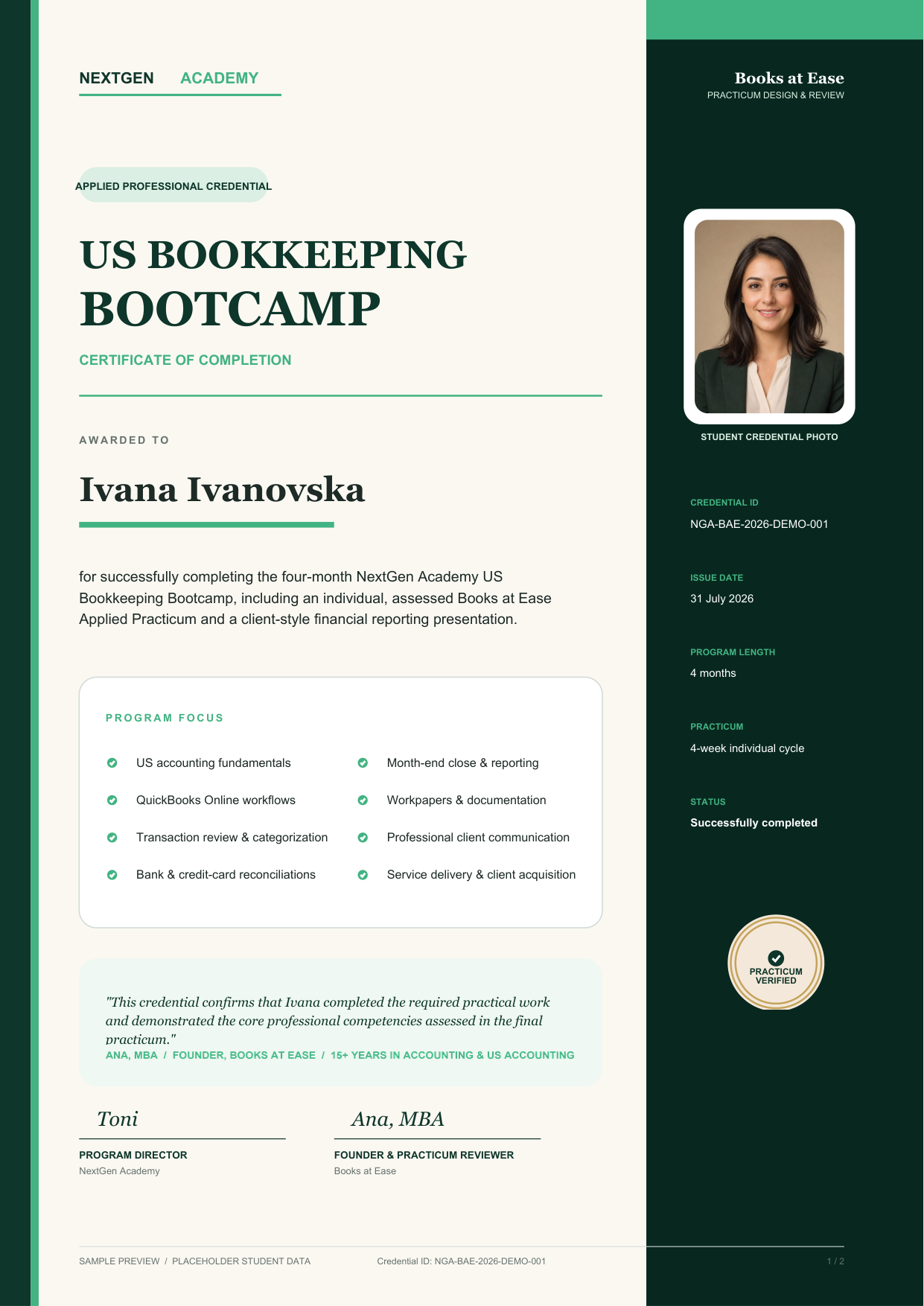
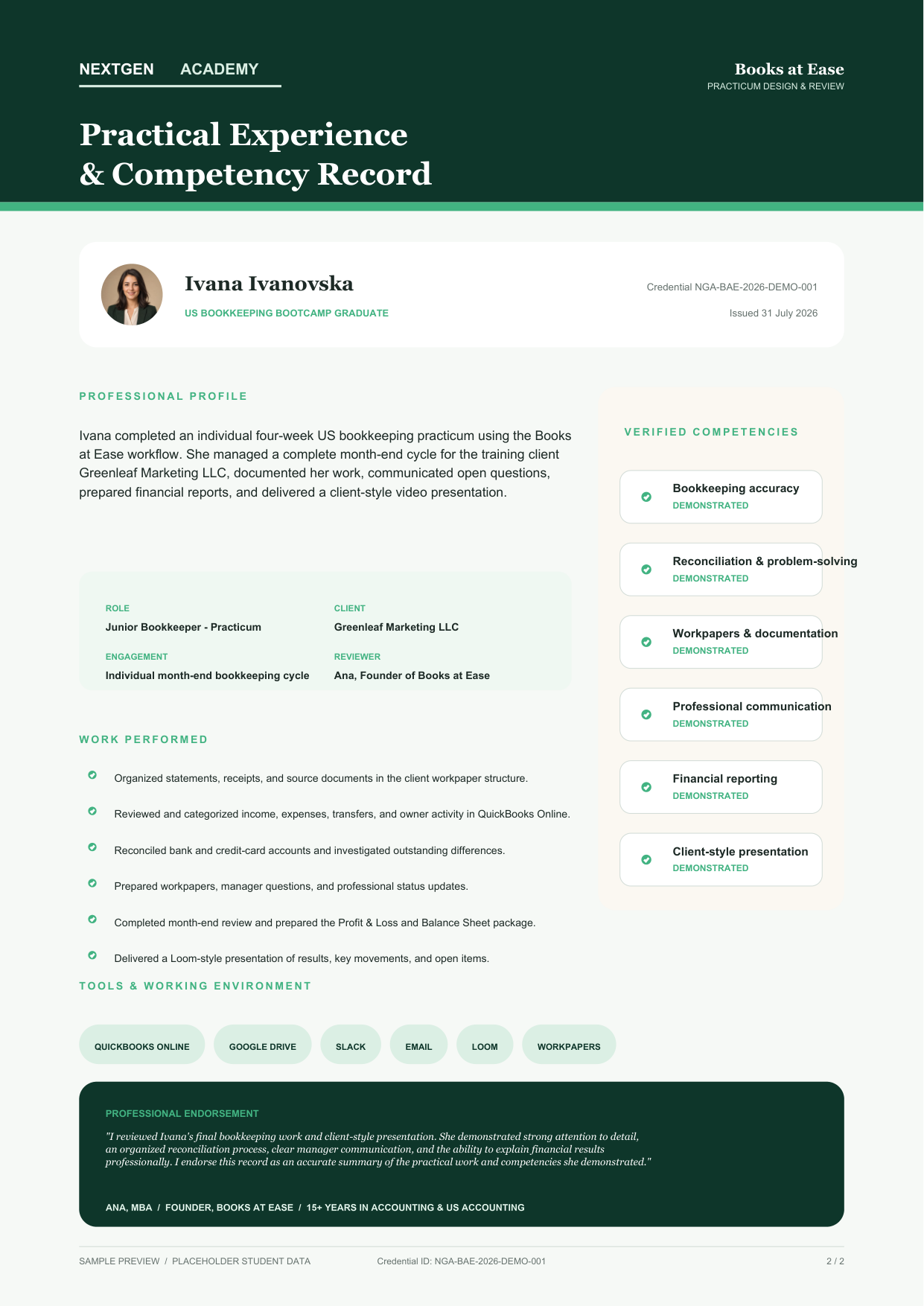
Sample preview with placeholder student data.
Leave your details and we’ll call you. We’ll walk through the program, answer whatever you want to ask, and tell you honestly whether it’s right for you.
We own the practice you’re learning from, and we’re the same two people you’ll be speaking to for all four months.
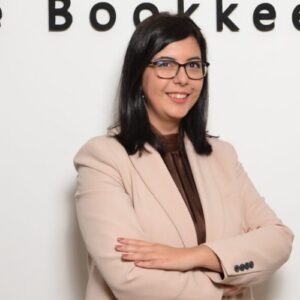
Lead instructor · Bookkeeping & QuickBooks
Ana leads the technical side of the program: the cycle, QuickBooks Online, reconciliation, month-end and workpapers. She also reviews the bookkeeping work you produce. She does this work on live US client books every week, which is why the lessons look like the job rather than like a textbook.

Mentor · Client work, communication & the practicum
Toni runs NextGen Company and Books at Ease, and takes the manager role in the fourth month. He covers the part of the job nobody teaches: how you write to a US client, how you ask a question that gets answered, how you scope and price work, and how you find it in the first place.
All of it is yours to keep and to show.
We can give you the skill, the environment, the experience and honest feedback. What you do with them is yours. Anyone promising you the rest is selling you something else.
The monthly plan costs the same whenever you join. What changes is the one-payment price: it steps up on 1 September and again on 16 September. Nothing is paid on this page — we arrange the transfer with you on the call.
One transfer before the program starts. The earlier you decide, the less it costs.
Available now
Until 31 August
€580 once
Saves you €420 against the monthly plan.
Next step up
1–15 September
€760 once
Saves you €240 against the monthly plan.
Full price
From 16 September
€850 once
Saves you €150 against the monthly plan.
€250 × 4€1,000 in total. One payment before each month starts, so you pay as you go. This price is the same whenever you join — the discount is for paying in advance.
The dates are the whole of it. No countdown on this page, no “six seats left”, no rate that quietly expires on a Friday. The price steps up on a calendar you can read, and it is lower now because deciding early is what lets us plan the group. The one limit that is not about money: we take 25 to 30 people, because beyond that we can’t read everyone’s work and sit down with everyone individually — and that is the part worth paying for.
Yes, the program is built for exactly that. There is no degree requirement, no experience requirement and no entry test. Plenty of people running bookkeeping businesses in the US started with no finance background at all, and we see no reason that door should be closed here. What you do need is the hour a day.
Teaching, explanation and support are in Macedonian. English is what you learn rather than what you’re tested on: the terminology, the QuickBooks fields, the source documents, the client emails and the reports. If you can read this page, you can start.
It’s designed for exactly that. One live hour a week, 18:00 to 19:00, and it’s recorded, so if you miss it you watch it later. Beyond that, budget about an hour a day for the exercises and your own practice.
We don’t promise that, and we won’t. We don’t place graduates and we don’t hand out client work. What we do give you is the skill, four months inside how the work really runs, a completed cycle you can show, and honest feedback on it. That’s real, and it’s the part we can actually control.
Books at Ease is a registered US bookkeeping practice with American small-business clients, run from Macedonia. NextGen Company supports more than 100 US accounting practices with a team of over 20 accountants. Toni and Ana run both, and they are the people teaching you. The fourth month puts you inside a training replica of how that firm actually works.
No, and we’re careful about this. You get a practicum: you work the way our team works, on our processes and our templates, with our founders reviewing you. You are not employed, you are not paid, and you never touch a real client or a real client file. The client you work on is one we built for the program. Everything else about it is the real thing.
A full bookkeeping cycle you completed on your own: organized files, workpapers, categorized and reconciled accounts, month-end adjustments and financial reports, plus a recorded client presentation and written individual feedback. On top of that, a two-page credential that records the engagement, the work you performed and the competencies Ana assessed. Work you can show, rather than a certificate of attendance.
It isn’t, and we’d rather say so plainly than let the question sit. The credential is issued by us, not by an accrediting body. What gives it weight is that a working US bookkeeping firm puts its name to a specific description of work it reviewed, competency by competency, and that the work behind it is real and yours. That is what a reference from an employer is, and it’s what someone hiring a bookkeeper actually reads.
Two options. Four monthly payments of €250 — €1,000 in total, one payment before each month starts. Or one payment in advance, which is cheaper the earlier you decide: €580 until 31 August, €760 from 1 to 15 September, €850 from 16 September. Payment is by bank transfer to our Macedonian company and we arrange it with you on the phone. There is no card payment and nothing is paid on this page.
Autumn 2026. We confirm the exact start date with everyone in the group before it begins, and we’d rather tell you the real date on the phone than invent one for a landing page.
We call you, and it will be Toni or Ana rather than a call center. We go through the program, answer everything you want to ask, and if it’s a fit we arrange the payment. If it isn’t, we’ll tell you that too.
Nothing is paid here. We call, we go through everything, and if it’s right for you we arrange the transfer after that. Filling this in commits you to nothing.
There’s no payment on this page and no obligation.
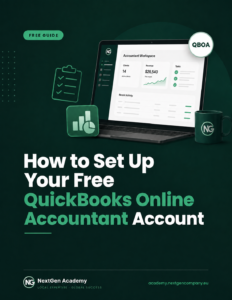
Step by step: how to open your free QuickBooks Online Accountant account and set it up correctly. Enter your email and it lands in your inbox.
You’ll also receive a short practical email series about working with US clients. Unsubscribe anytime.